
Growing Your Property Portfolio
When is the right time to buy your next investment property?
Buying another investment property isn't only about whether the new property stacks up. Once you already own property, the decision can affect your debt, equity, cash flow, returns and the shape of your entire portfolio.
Buying the next investment property is a portfolio decision — not simply another isolated property calculation.
A different question
Buying the next property changes the question
Evaluating a first or standalone investment can begin with relatively simple questions — what it will cost, what rent it might generate, what expenses to expect, and what yield it might produce. Once you already own property, another acquisition interacts with an existing financial position.
Does this property stack up?
What would buying this property do to everything I already own?
The second question may involve existing debt, available equity, portfolio cash flow, financing capacity, and whether existing assets should be retained at all.
Where it starts
Start with the property — but don't stop there
Every acquisition still begins with the property itself. The attractiveness of an investment depends on the assumptions you make about it.
Akweno Insight
What do investors model?
Across hundreds of scenarios modelled using Akweno's Rental Yield Calculator, property value is the variable investors model most, closely followed by expected rent. Investors also test expense assumptions — and purchase price and rent are the two variables most commonly explored together.
Property value
Most commonly modelled
The purchase price is the first thing investors change — it moves both the yield and the capital required.
Rental income
Close second
Expected rent is tested almost as often, and is the variable most commonly explored alongside price.
Property expenses
Also regularly tested
Ongoing costs are adjusted to pressure-test the net return, not just the headline gross yield.
The attractiveness of an investment depends on the assumptions you make.
- Change purchase price → yield changes
- Change expected rent → yield changes
- Change expenses → net return changes
Testing the assumptions
Investors don't always model a property just once
Akweno calculator behaviour shows investors returning to assumptions they've already entered and changing them to explore alternative outcomes.
What if I negotiated another $25,000 off the price?
A lower entry price lifts yield and lowers the capital at risk.
What if achievable rent is $30 per week lower than expected?
A softer rent assumption tests how much headroom the deal really has.
What if expenses are higher than I initially allowed for?
Heavier costs show whether the net return survives a tougher year.
A rental yield calculator can answer these questions quickly. But once you already own property, they're only the first layer of the decision.
What would buying this property do to the portfolio I already have?
From property to portfolio
Your next property changes the portfolio you already have
A prospective purchase should now be considered alongside the portfolio you already own. The property's yield still matters — but it becomes one input into a larger investment decision.
How much additional debt will I take on?
What happens to my portfolio LVR?
How does portfolio cash flow change?
What happens to my equity position?
Does the acquisition improve or dilute overall portfolio yield?
How does the resulting portfolio compare with doing nothing?
John & Sarah consider their next property
John and Sarah already own investment property and are considering another purchase. The prospective property looks attractive on its own — but they want to understand what buying it could mean for their entire portfolio before making the decision.
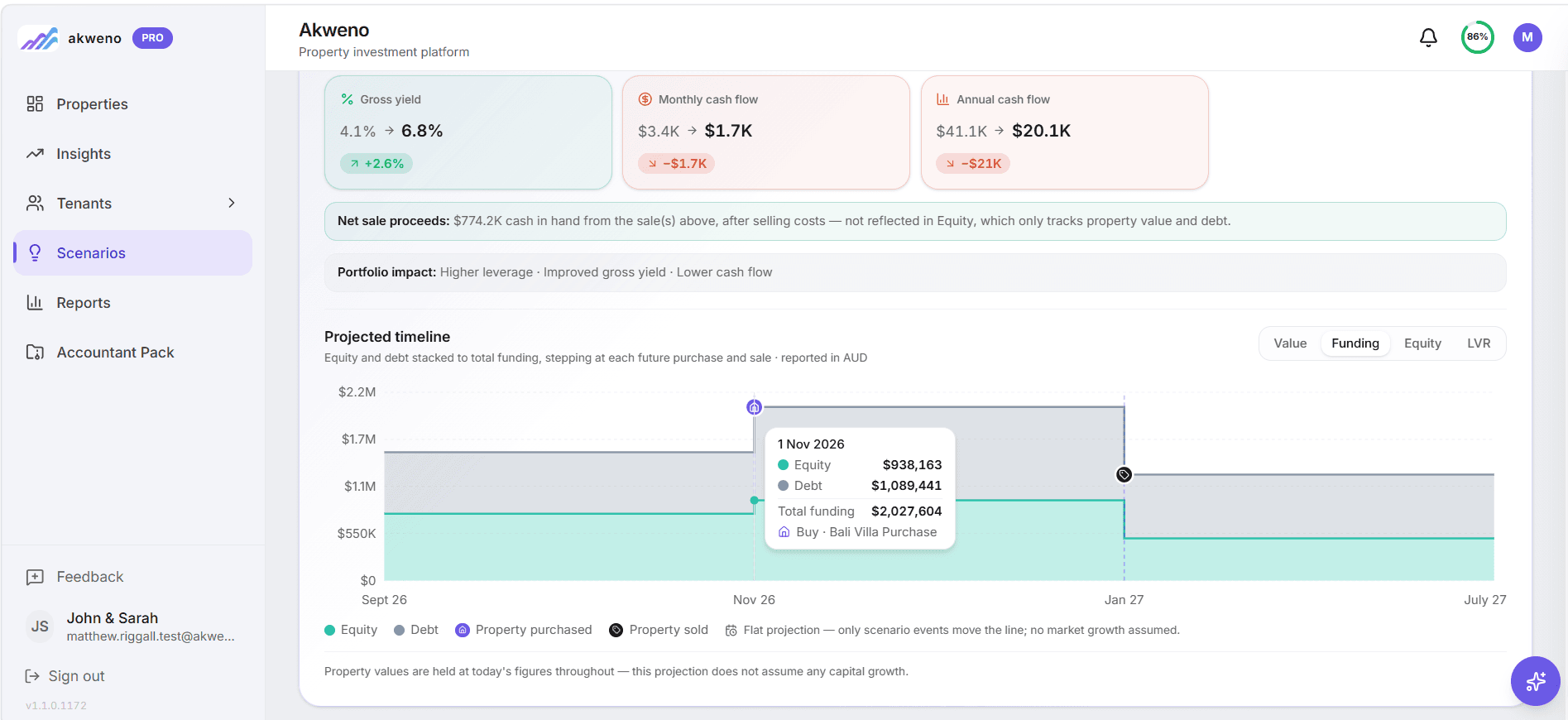
John & Sarah can create a proposed purchase as a scenario rather than immediately adding it to their real portfolio. The scenario lets them compare their current portfolio with the portfolio including the proposed acquisition — side by side, before committing to anything.
Instead of a single yield figure, they can see how the whole position moves across every dimension that matters.
What the comparison shows
- Portfolio value
- Total debt
- Equity
- LVR
- Gross yield
- Monthly cash flow
- Annual cash flow
- Projected portfolio timeline
The question has moved from “What yield does this property produce?” to “What does owning this property do to our portfolio?”
A strategic choice
Should you sell one property to buy another?
Buying and keeping everything is only one possible scenario. John & Sarah could compare three strategic choices — and there's no universally correct answer.
Keep the existing portfolio
No acquisition.
The baseline — what the portfolio looks like if nothing changes. Every other scenario is measured against this.
Buy and keep everything
Fund the purchase without selling.
Adds the new property on top of the existing portfolio, increasing the asset base but also the debt and financing commitments.
Sell one, buy the next
Release equity from an existing asset.
Frees up equity to put towards the acquisition, reducing borrowing — but removes an income-producing asset and its future growth.
Selling to release equity
May release equity and reduce borrowing requirements — but removes an income-producing asset and its potential future growth.
Keeping everything
May increase the asset base and potential income — but could materially increase debt and financing commitments.
There is no universally correct answer. The purpose of scenario modelling is to make the trade-offs visible.
The transition problem
What if you need to buy before you sell?
Investment decisions don't always happen in a neat sequence. John & Sarah may decide selling an existing property makes sense — but the property they want may be available now.
Buying before selling creates questions of its own:
- The temporary financing requirement
- Peak debt across the transition
- Portfolio LVR while both properties are held
- Additional interest and holding cost
- How long the bridge may need to be carried
- What happens if the existing property takes longer to sell
Timing itself becomes another scenario variable.
The widening lens
From property scenarios to an investment plan
The same decision looks different at each level. As you zoom out, the analysis widens from a single property to the whole plan.
Property level
What yield could this property produce at this price and rent?
Purchase level
What would it cost me to acquire and finance?
Portfolio level
What happens to debt, equity, cash flow, yield and returns if I buy it?
Alternative scenario
What happens if I sell another property as part of the transaction?
Transition
What happens if I need to carry both properties for a period?
The objective isn't to produce a single number telling you whether to buy. It's to make the trade-offs visible before you make the decision.
How Akweno helps
Model the next property as part of your portfolio
Akweno lets property investors bring existing investments and prospective purchases together, so different scenarios can be considered in the context of the portfolio they would actually create.
The important question isn't only whether the next property works. It's whether it works with everything you already own.
Explore the numbers
Calculators for the next-property decision
Start at the property level, then widen the question to the portfolio.
Rental Yield Calculator
Test purchase price, rent and expenses on a prospective property before it ever reaches the portfolio question.
Open calculatorCash Flow Calculator
See what a property adds to — or takes out of — your weekly position once rent meets every cost and the loan.
Open calculatorLVR Calculator
Check loan-to-value ratio property by property — the building block of a portfolio-wide gearing view.
Open calculatorEquity Forecast Calculator
Project the value and equity you could release from an existing property to fund the next one.
Open calculatorRelated reading
Continue across the portfolio
This topic sits alongside the wider Akweno knowledge base. Explore the connected topics and concepts that shape a growing portfolio.
Property Portfolio Management
The lens that rolls every pillar up across everything you own.
Investment Property Forecasting
Carrying every property from today's numbers into a plan.
Capital Growth & Property Value
How value and equity build — the growth you give up if you sell.
SEE MORE. DECIDE AHEAD. BUILD WEALTH.
Model your next property as part of your portfolio
Bring your existing investments and a prospective purchase together in Akweno, and see how the whole portfolio changes before you decide.
Cancel anytime · Start Basic with a 7-day free trial